
I’d heard that Xenosaga Episode 1 was a really good game. What I wasn’t expecting was how the plot would end up living rent free in my brain after finishing it…
Overview
Released in 2002 in Japan for the PlayStation 2, Xenosaga Episode 1 was developed by Monolith Soft and was actually the first game this now relatively prolific studio released. It was subsequently released to the US in 2003, but never made its way over to Europe for some reason.
As such, I never actually got the chance to play it growing up.
I did get to play Xenosaga Episode 2, which was released in Europe, and whilst I can’t remember much about the game, I remember I enjoyed it. So I always wanted to play through the entire trilogy and really experience what this story had to offer.
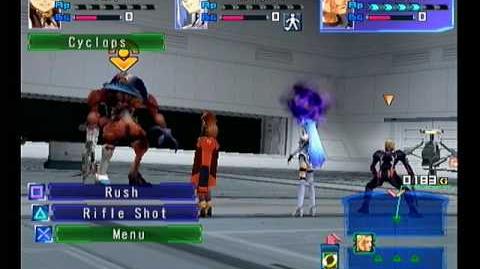
That said… Going into Xenosaga Episode 1 over on my Twitch channel, I had pretty much zero expectations as to what the game would be like beyond a vague recollection of mecha appearing in the second game, and the fact that I’ve heard people say the first game is really good.
Release Context
One thing that I always want to do when I look back at the RPGs I play on stream is to look at them within the context of when they were released. With Xenosaga Episode 1, that means we need to look at what the RPG genre was like in 2002 – what was the game up against at the time? What sort of genre defining changes were taking place?
And, well, I guess the biggest elephant in the room would be the fact that Final Fantasy X had released less than 12 months earlier.
FF10, along with the move to the PS2 in general, had brought about a significant shift in the RPG genre. The PS2 had launched with so-called RPGs like Orphen: Scion of Sorcery which, whilst not a good game, had shown that even the “lower end” RPGs could now be voiced.
Then came FF10 with its incredible cutscenes, cinematography and the typical depth of a Final Fantasy game’s plot that we all expected. Add to this the fact that Kingdom Hearts, Morrowind and Pokemon Ruby and Sapphire all released in 2002, and you can see that Xenosaga Episode 1 dropped in what was a rather stacked year!
So why is it that, amongst all of these big hitters, Xenosaga still gets remembered so fondly?
Core Gameplay
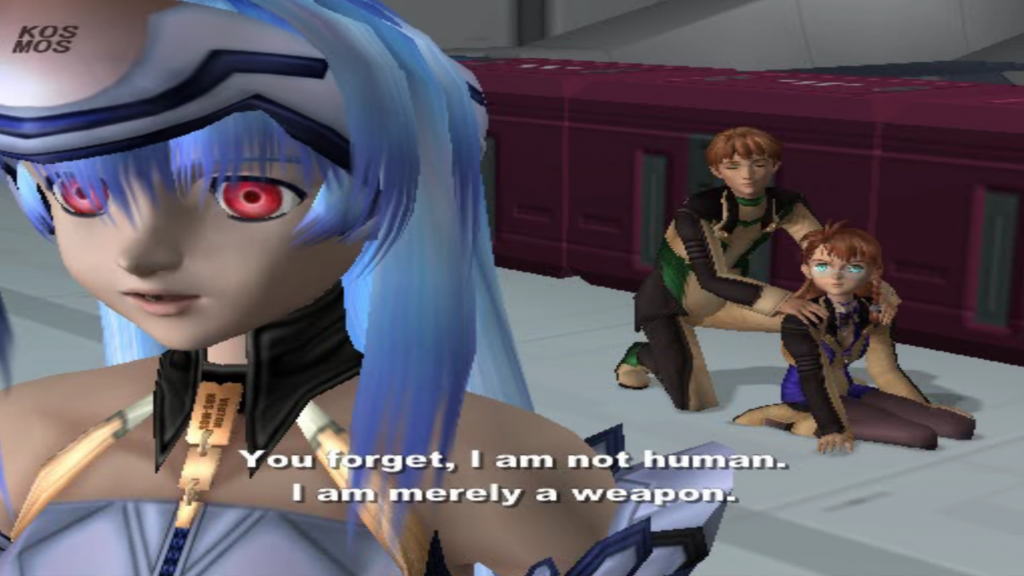
One of the first things to mention about Xenosaga Episode 1, in terms of the core gameplay, is that it is actually a rather linear RPG. Similar to Final Fantasy X, the game follows a pretty strict “dungeon to dungeon” progression that doesn’t offer much in the way of side exploration.
An Elder Scrolls game, this is not.
Xenosaga has a story to tell, and the telling of that story takes paramount over world exploration. But not in a bad way.
Whereas Final Fantasy X has you effectively follow a straight line northward through the world as the story unfolds, Xenosaga takes you from location to location via cutscene, but each location is a large, sprawling area for you to run around in.
In short, Xenosaga hides the linearity of the location progression by making each location feel like a labyrinth to explore. It’s a game of micro exploration, rather than macro exploration.
Continuing the comparison with Final Fantasy X, since its one of the best comparisons I can make for the time period, Xenosaga further masks the linearity better than FF10 through its “EVS System”. Basically, at certain save points, you can use the EVS System to go back and revisit any dungeon you have previously finished.
Imagine getting access to the airship in FF10, but only for places you have already visited, and available immediately after leaving Besaid.
This gives you an added feeling of exploration in an otherwise very linear, story-focused game. It’s also, from my experience, one of the best ways to level up and grow your party.
You see, leveling in Xenosaga is a little different from most JRPGs that came out in 2002.
Yes, you gain experience points from battle which give your characters level ups. However, what is arguably more important is the number of Tactical Points you accumulate from battles.
These tactical points can be spent to either improve attacks and skills, or improve individual stats. For example, you can spend your tactical points to boost your HP by 10 points per boost, which goes on top of the growth you would naturally get from leveling up.
And getting points from battle doesn’t specifically require you to always be fighting the most “current” enemies. Instead, using the EVS system to go back and fight enemies from the most recently finished dungeon can actually prove to be the best use of your time when it comes to grinding.
This is especially so when you take advantage of the phased system in combat. Which brings us nicely to the next part of this retrospective.
Systems & Mechanics
At the heart of the game, Xenosaga is your typical JRPG, mechanically speaking. It has menu driven shops, overworld exploration, and turn based combat.
However, where Xenosaga Episode 1 really shines is how it takes these basic concepts and really plays with your expectations of them, starting off with combat as you get thrown into a battle tutorial almost immediately.
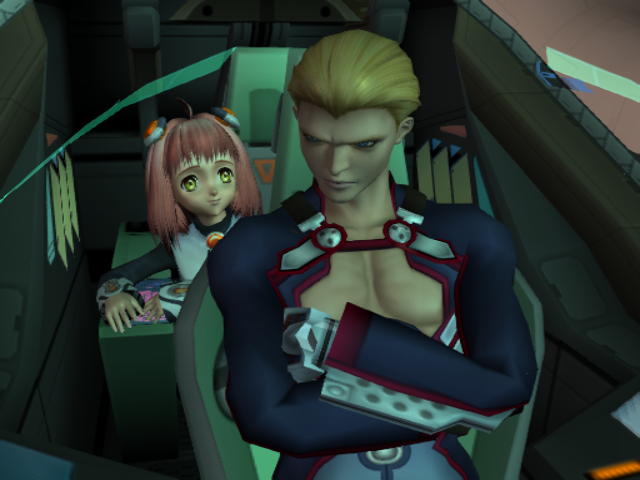
You see, unlike most turn based JRPGs, Xenosaga doesn’t entirely rely on menu driven combat. You don’t have an “attack” option at the top of a character’s action menu. Instead, each character’s turn starts with a list of button prompts and associated attacks overlaid on the screen, which work similar to a combo input from a fighting game.
The Square button corresponds to close range attacks, Triangle is ranged, and Circle is basically a “big hitter”. And depending on how many Action Points that character has available that turn, you can perform combos of different lengths.
For example, if Shion has 4 out of 6 action point bars filled, you could choose to press Square twice in a row to use all 4 points and do 2 close range attacks. Then, on Shion’s next turn, she’ll have 4 points to use again.
Alternatively, you could choose to do a single attack with Square at a cost of 2 action points, then press X to end the combo early and save the last 2 points. Then, on Shion’s next turn, she’ll have 6 action points available to do a “full combo” of, for example, Square, Square and Circle to end with a big hitter attack.
Further still, you could choose to ignore the basic combo attack entirely that turn, pressing X to bring up a more typical JRPG battle menu to use skills, magic, items or jump into the pilot seat of a mech.
This gives what is otherwise a pretty standard turn based battle system a feeling of being fresh and somewhat unique. Which is also helped by the previously mentioned phase system.
Each turn of the battle moves to a different “phase”, indicated by an icon to the left of the turn order window. These phases affect both your party and the enemy, and have effects such as increased critical hit rate, increased defense, or one of the most useful – increased point gain, which is shown by the icon of a coin.
Keeping track of the battle phases is key to character progression in Xenosaga, because killing an enemy during the “coin phase” can give you double, quadruple or even ten times the tactical points you would have gotten from that enemy otherwise.
This creates a level of tactical planning that I haven’t really experienced in other JRPGs. Do you go for the full combo on an increased damage phase to secure the kill, or do you wait it out to try and go for the extra points, and will you survive until you can kill the enemy during the coin phase?
All of these little tweaks and unique takes on the turn based combat formula really stand out to me, and if I’m honest, made it one of the most enjoyable battle systems I’ve experienced in an JRPG.
However, it’s not without its flaws…
Before starting Xenosaga, one of the biggest draws to the game and series as a whole for me was the fact that it was an RPG with mecha in it. And the way the mecha are included is really cool!
You can buy parts for them, upgrade them, get new weapons and create different load outs… Not the same level as something like Armoured Core, but the ability to create your own custom builds is there.
Sadly, because of the way the mecha work in battle, I found myself just not really using them. To start with, it costs you a turn to actually board a character’s mech, which can screw up planning around the battle phases. But the worst part of how mechs are handled in battle is what happens when one hits 0HP.
The mechs, called AWGS, have separate healing items to characters, which don’t appear in the battle menu. So you can’t actually heal the mechs easily. Then, when one reaches 0HP, rather than switching back to the character piloting it, like how Yuna’s summons would switch back to Yuna, both the mech and the character become unusable for the remainder of the battle.
You just lose them. And there is no way to “revive” the mech during battle, at least not that I found during my playthrough.
So whilst the AWGS do give extra health, extra defense and potentially an increased damage output compared to your normal characters, they come with the huge risk of potentially just flat out losing a third of your party each time they go down.
Story
So, at the start of this article I mentioned that the plot is now living rent free in my brain. That is not an understatement. We finished the playthrough on stream during my last stream of 2025, before taking a break for Christmas.
At the time of writing this article, it is a week later and I cannot stop thinking about this plot. Even when I was cooking the Christmas dinner, I was still replaying scenes in my head.
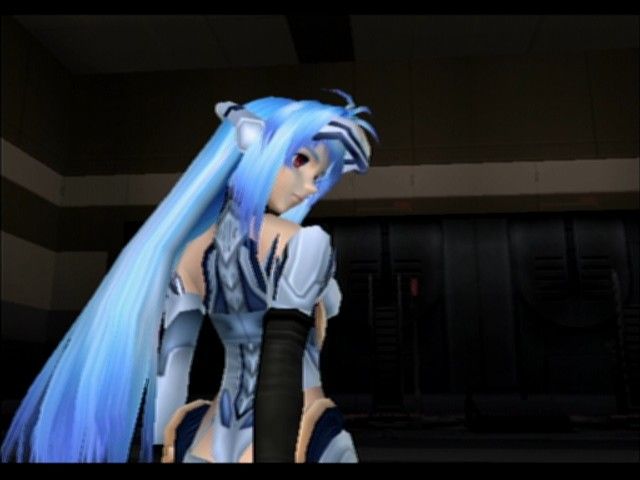
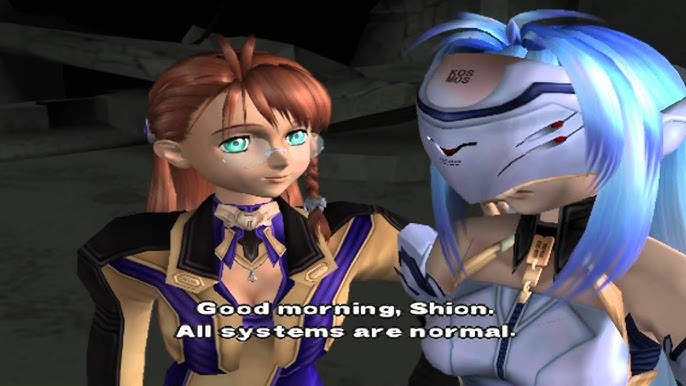
The game starts off following Shion as she works on trying to get the development of KOS-MOS complete onboard a spaceship when the Gnosis attack. Now, I’ve come to refer to the Gnosis as “space ghosts”, since I still don’t actually know what they are – this is episode 1 of 3, after all.
From there, we jump to different scenarios to introduce the various party members before they all come together onboard the Durandal. During these scenarios, we see KOS-MOS sacrifice a party member to kill a Gnosis, the character of chaos (spelt with a lower case c) freeze Gnosis in place and then shatter them from existence, and a Commander who is clearly a double-agent start turning into a Gnosis.
And yet, it’s when everyone comes together that things really go crazy…
We learn that the Kukai Foundation have been gathering these strange monoliths called “Zohars”, with each one named after one of Jesus’ disciples, to keep them away from the UTIC organisation.
We see the UTIC organisation flat out erase a planet when testing a fake Zohar.
We learn about some cthulu-like being called UDO who threatens the known universe, and see a vision of KOS-MOS fighting UDO as a planet which leads to a kamehameha struggle so strong it obliterates the galaxy.
Then there’s the creepy girl that I nicknamed Aura (a Dot Hack reference) that apparently lives in a different dimension alongside two other creepy girls who spend eternity dancing around the corpse of their caregiver… And we are asked to help them wake up, with no further context given during Episode 1.
Then there’s the scene with KOS-MOS where she’s basically being crucified, and the fact that apparently her and Shion have some method to block Albedo’s access to the data around Second Milita and/or the Gnosis… I’m still not entirely sure what they are blocking…
Oh, and of course there’s the bit where Albedo rips off his own head, stamps on it, and grows a new one! And whilst I have no actual idea, I have a strange feeling that chaos is going to turn out to be the angel Gabriel or something like that…
Now, obviously, since this was my first time playing through Episode 1 and I can’t remember any details from Episode 2, I have no idea where all of these plot threads will go.
But what I can say is this; the plot of Xenosaga Episode 1 is an absolute fever dream and I loved every single second of it.
Final Verdict
Now, I think the best way that I can summarise my opinion on Xenosaga Episode 1 is by telling you all that, whilst writing the first draft for this article, I was realising how much I actually loved my time playing the game so much that in my spreadsheet of “favourite games”, I moved it from position 20 to position 11.
The entire game feels like the craziest fever dream I’ve ever had in terms of storyline, in the best possible way. And the combat system is one of the most enjoyable JRPG battle systems I’ve experienced.
The music, whilst few and far between, is top tier. And whilst the extended use of ambient silence in dungeons was a bit frustrating, everything else was just so good. The voice acting was amazing, including the likes of Batou from Ghost in the Shell and Tsukasa from Dot Hack//SIGN.
Even if I were to do another comparison to Final Fantasy 10 like I was doing earlier in the video, I would say the level of voice acting quality for the cast as a whole is arguably better than FF10s.
So yeah, in short, if you like great turn based combat, absolutely insane storylines, and incredible voice acting, I highly recommend you play Xenosaga Episode 1.
And if you have played through it already, without telling me anything about Episode 2 or 3, what is your opinion of Xenosaga Episode 1?